The Cord of the Ancestors
San Pedro is a sacred, columnar, fast-growing visionary cactus native to the high-altitude slopes of the Andean mountain range, stretching through Peru, Ecuador, Bolivia, and northern Chile. Known scientifically as Trichocereus pachanoi (and recently reclassified by some botanists as Echinopsis pachanoi), it thrives at elevations between 6,000 and 10,000 feet.
The name “San Pedro” was given to the plant by Spanish conquistadors and missionaries following the colonization of Peru. Observing its profound visionary power, they named it after Saint Peter—the Christian saint who holds the keys to the gates of heaven—because the medicine was understood to be an immediate, undeniable key to the celestial realms.
However, its original, ancestral name used across the Andes for over 3,500 years is Wachuma (also spelled Huachuma), a traditional Quechua word that translates beautifully to “that which renders the mind conscious” or “the awakening.” Along with Ayahuasca and Peyote, Wachuma represents one of the oldest continually utilized entheogenic master plants on Earth.
The Molecular Alchemy
Unlike the complex binary chemical team-up required for Ayahuasca, San Pedro is entirely self-contained. It stores its master visionary key directly within its green, fleshy flesh:
- Mescaline ($2\text{-(3,4,5-trimethoxyphenyl)ethanamine}$): A naturally occurring phenethylamine alkaloid. Mescaline acts as a powerful agonist, binding directly to the serotonin $5\text{-HT}_{2\text{A}}$ receptors in the human brain. This interaction temporarily alters how information flows through the nervous system, heightening sensory processing, dissolving rigid psychological conditioning, and opening up a vast landscape of fluid, lucid contemplation.
- Supportive Alkaloids: The cactus contains a panoramic suite of secondary trace alkaloids (such as hordenine, tyramine, and 3-methoxytyramine) that work in tandem with the mescaline, gently balancing its absorption rate and smoothing out the physical delivery.
What It Means to Indigenous People
To understand Wachuma through the eyes of the ancient Andean peoples—such as the pre-Inca Chavín, Cupisnique, Moche, and Nazca civilizations—one must step out of the dark, internal world of the jungle and step into the vast, expansive light of the high mountains.
   [ CHAVÍN DE HUÁNTAR ]
            │
            ▼
    [ THE CHAKANA ]  ───► A cross-cultural, multi-millennial anchor connecting
            │            the Underworld, Earthly Realm, and Sky World.
            ▼
   [ UNIFIED LIGHT ]
1. The Gateway of Chavín de Huántar
The spiritual heart of Wachuma is anchored in the ancient temple complex of Chavín de Huántar (dating back to roughly 1200 BCE) in the central highlands of Peru. Carved directly into the circular stone plazas of this temple are large, monolithic bas-reliefs depicting mythological jaguar-priests holding towering stalks of the San Pedro cactus. For the Chavín people, Wachuma was the supreme catalyst used to initiate priests, communicate with mountain spirits (Apus), and establish balance between the community and the cosmos.
2. The Architecture of the Chacana
In Andean cosmology, Wachuma is fundamentally an Earth-grounding and Sky-connecting medicine. While Ayahuasca often pulls the consciousness down into the internal, subterranean underworld of the psyche to purge old trauma, Wachuma expands the awareness outward into the blinding light of creation. It is deeply associated with the Chacana (the Andean step-cross), serving as the vertical axis that connects the three realms of existence:
- Uku Pacha: The internal, subterranean underworld of the subconscious and ancestors.
- Kay Pacha: The physical, present-moment earthly realm of human action.
- Hanan Pacha: The celestial upper world of divine order, cosmic law, and high spirits.
3. A Medicine of Heart, Clarity, and Action
To indigenous practitioners, Wachuma is not a passive or dreamlike visionary experience; it is an active, awake state of deep somatic mindfulness. It is considered a profoundly compassionate, masculine teacher that opens the heart, dissolves the analytical grip of the ego, and reveals the hidden, divine geometry connecting all living things. It teaches Ayni (sacred reciprocity)—the absolute necessity of living in absolute harmony with the community, the waters, the soil, and the mountains.
How It Is Prepared & Used
The ritual administration of Wachuma is a beautifully patient, day-long event that honors the solar cycles of the high Andes.
1. Selection and Harvesting
A traditional healer (Maestro Wachumero or Curandero) begins by selecting a mature, wild cactus, typically looking for stalks that have aged for several years to ensure a rich, fully developed alkaloid profile. Traditional lineage keepers pay close attention to the number of vertical ribs on the column—cacti with seven or nine ribs are highly prized for their balanced spiritual geometry, while rare four-ribbed columns are considered intensely sacred “guardian stars,” symbolizing the four cardinal directions and four elements.
2. The Preparation (La Cocina)
Preparing the medicine requires immense manual labor and reverence:
- De-thorning: The sharp, outer needles are carefully cut away one by one.
- Harvesting the Emerald Layer: The dark green outer skin directly underneath the waxy translucent cuticle holds the vast majority of the mescaline. The inner white, pulpy core contains very little medicine and is discarded to minimize unnecessary physical nausea.
- The Reduction: The green strips are chopped into small pieces and placed into a large copper or steel cauldron filled with pure mountain spring water. The mixture is boiled down over a roaring wood fire for anywhere from 7 to 14 hours. The liquid is strained, concentrated, and cooled into a thick, remarkably bitter, and earthy olive-green fluid.
3. The Ceremony (The Mesa)
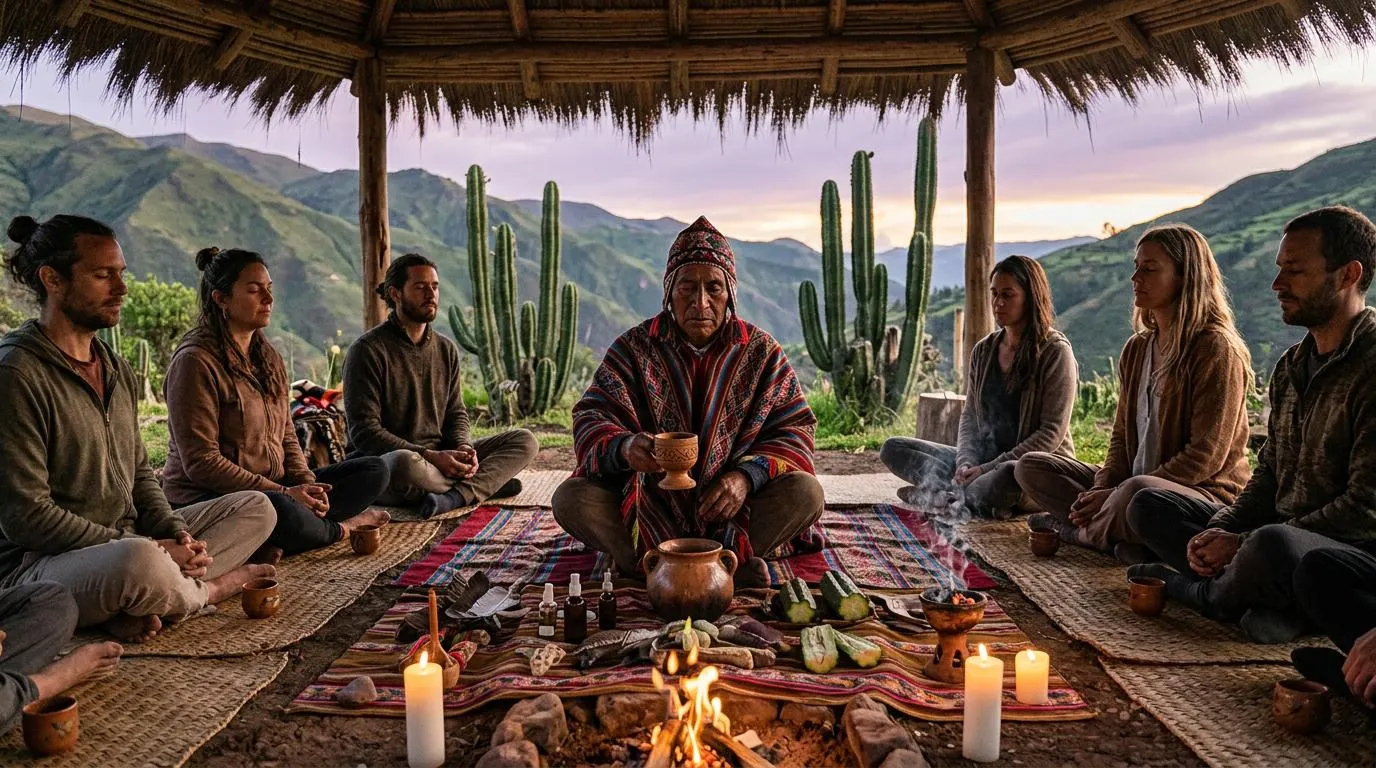
Unlike Ayahuasca, which is held in absolute darkness at night, traditional Wachuma ceremonies are often conducted during the day, under the warmth of the sun.
The ceremony centers around the Mesa—a sacred altar arranged on a beautifully hand-woven textile, populated with carefully curated objects that hold personal and ancestral power:
- Artes (Power Objects): Dualistic stones representing masculine and feminine forces, pre-Columbian ceramics, carved wooden staffs, crystals, and sacred seashells.
- The Balancing Act: The Maestro utilizes these objects systematically throughout the day to balance the opposing energies of the participants, clearing away dense blocks (jucha) and inviting bright, revitalizing cosmic force (sami).
4. The Journey of the Sun
The participant drinks the bitter brew early in the morning. Because mescaline is absorbed slowly through the digestive tract, the onset begins gently over 1 to 2 hours.
The journey plateaus for a long, luminous 10 to 14 hours. There is rarely a violent physical purge like Kambo or Ayahuasca; instead, the body feels a wave of heavy, steady physical grounding. As the eyes adjust, the physical world begins to breathe. The textures of the earth, the rustle of the trees, and the massive presence of the mountains are experienced not as objects, but as a living, breathing family. The practitioner walks, sits, and dialogues directly with nature, returning to everyday life with an open heart, crisp mental clarity, and an enduring sense of deep, unshakeable peace.