The Wand of the High Andes
Peruvian Torch is a sacred, magnificent columnar cactus native to the high-altitude western slopes of the Peruvian Andes, thriving at elevations between 6,000 and 10,000 feet. Known scientifically as Trichocereus peruvianus (and classified by some contemporary botanists as Echinopsis peruviana), this fast-growing, multi-ribbed master plant is a sibling species to the famous San Pedro cactus (Trichocereus pachanoi).
While sharing a similar botanical lineage, the Peruvian Torch is visually distinguished by its frosted, striking blue-green or frosted-aquamarine hue and its long, formidable, honey-colored spines that can reach up to 4 inches in length.
Across its native habitat in Peru, it is traditionally known alongside its sibling as Wachuma (or Huachuma), a traditional Quechua term translating to “that which renders the mind conscious” or “the awakening.” It represents a multi-millennial entheogenic anchor that has illuminated the spiritual architecture of South American indigenous cultures for millennia.
The Molecular Alchemy
Like its smooth-skinned sibling San Pedro, the Peruvian Torch requires no complex binary mixing to unlock its visionary properties. Its medicine is stored directly within the green tissue of its ribbed columns:
- Mescaline ($2\text{-(3,4,5-trimethoxyphenyl)ethanamine}$): A naturally occurring phenethylamine alkaloid that binds directly to the $5\text{-HT}_{2\text{A}}$ serotonin receptors in the human brain. This interaction dissolves the rigid grip of the ego, expands sensory awareness, and opens a vast landscape of lucid, interconnected contemplation.
- A Dense Alkaloid Profile: The Peruvian Torch is highly prized by specific lineage keepers because it often carries a distinct, highly concentrated profile of secondary trace alkaloids (such as tyramine, hordenine, and 3-methoxytyramine). This complex chemical matrix frequently gives the Peruvian Torch a reputation for delivering a more intensely physical, grounding, and lightning-sharp entry compared to other mescaline-bearing cacti.
What It Means to Indigenous People
To understand the spiritual weight of the Peruvian Torch through the eyes of ancient Andean civilizations—such as the pre-Inca Chavín, Cupisnique, Moche, and Nazca cultures—one must step out of the dark, subterranean internal world of the jungle and step into the vast, blinding, all-encompassing light of the high mountains.
   [ THE ANDEAN COSMOLOGICAL SPECTRUM ]

       Hanan Pacha (The Sky World)      ──► Cosmic Order & Divine Light
            ▲
            │  ◄── [ PERUVIAN TORCH AXIS ] (The Vertical Gateway)
            ▼
       Kay Pacha   (The Earth Realm)    ──► Human Action, Ayni, & Reciprocity
1. The Shaman’s Direct Line to the Apus
To the indigenous peoples of the Andes, the Peruvian Torch is understood to be a direct manifestation of the Apus (the living spirits of the sacred mountains). Its long, sharp needles are not viewed merely as a physical defense mechanism, but as spiritual antennae that catch cosmic lightning and ground celestial frequencies directly into the earth. It is considered a fiercely protective, masculine medicine—a spiritual warrior that guards the practitioner against low-vibrational projections and dense environmental debris (jucha).
2. Living in Ayni (Sacred Reciprocity)
Wachuma is fundamentally an experiential teacher of Ayni—the core Andean philosophy of sacred reciprocity, harmony, and mutual exchange with all living things. When an indigenous practitioner drinks the medicine, it is not an escape from reality; it is a profound immersion into it. The cactus strips away the illusion of human separation, revealing that the soil, the rushing rivers, the wind, and the human heartbeat are all woven into a single, breathing cosmic tapestry.
3. The Visionary Wand of the Temple
Dating back to the ancient temple complex of Chavín de Huántar (circa 1200 BCE), columns of these sacred cacti were utilized by priests to initiate seekers into the higher mysteries. Carved stone reliefs inside the temple labyrinths depict half-human, half-jaguar deities clutching towering stalks of the cactus like royal scepters. To the ancestors, this plant was the ultimate catalyst for emotional purification, prophetic sight, and ancestral alignment.
How It Is Prepared & Used
The transformation of a spiny, towering cactus into a sacred ceremonial nectar is a deeply patient, day-long art form governed by prayer and strict energetic discipline.
1. Intentional Harvesting
A master healer (Maestro Wachumero) begins by selecting a mature, wild-grown column, often counting the vertical ribs of the cactus. Columns featuring 4, 7, or 9 ribs are held in incredibly high spiritual regard, as each number corresponds to traditional Andean sacred geometry, the cardinal directions, and the elemental forces of nature. The healer makes a traditional offering of tobacco or coca leaves to the base of the plant before carefully removing a section of the stalk.
2. Harvesting the Emerald Layer
The preparation of the Peruvian Torch requires meticulous, reverent manual labor:
- De-spining: Using a sharp blade, the practitioner meticulously cuts away the long, needle-sharp spines one by one.
- Stripping the Skin: The clear, waxy outer cuticle is peeled back.
- The Medicine Layer: The dark emerald-green tissue directly underneath the skin contains the vast majority of the mescaline alkaloids. The inner, white pulpy core contains very little medicine but carries high concentrations of components that induce intense physical nausea; therefore, it is carefully carved away and discarded.
3. The Long Brew (La Cocina)
The green strips are finely diced or blended, placed into a massive cauldron filled with pure mountain spring water, and boiled over an open wood fire for anywhere from 8 to 14 hours. As the liquid slowly reduces, it transforms into a thick, remarkably bitter, opaque olive-green fluid that is strained through cloth and cooled for ceremonial use.
4. The Journey of the Sun
Unlike Ayahuasca, which is held in absolute darkness at night, traditional Peruvian Torch ceremonies are beautifully executed during the day, under the open sky.
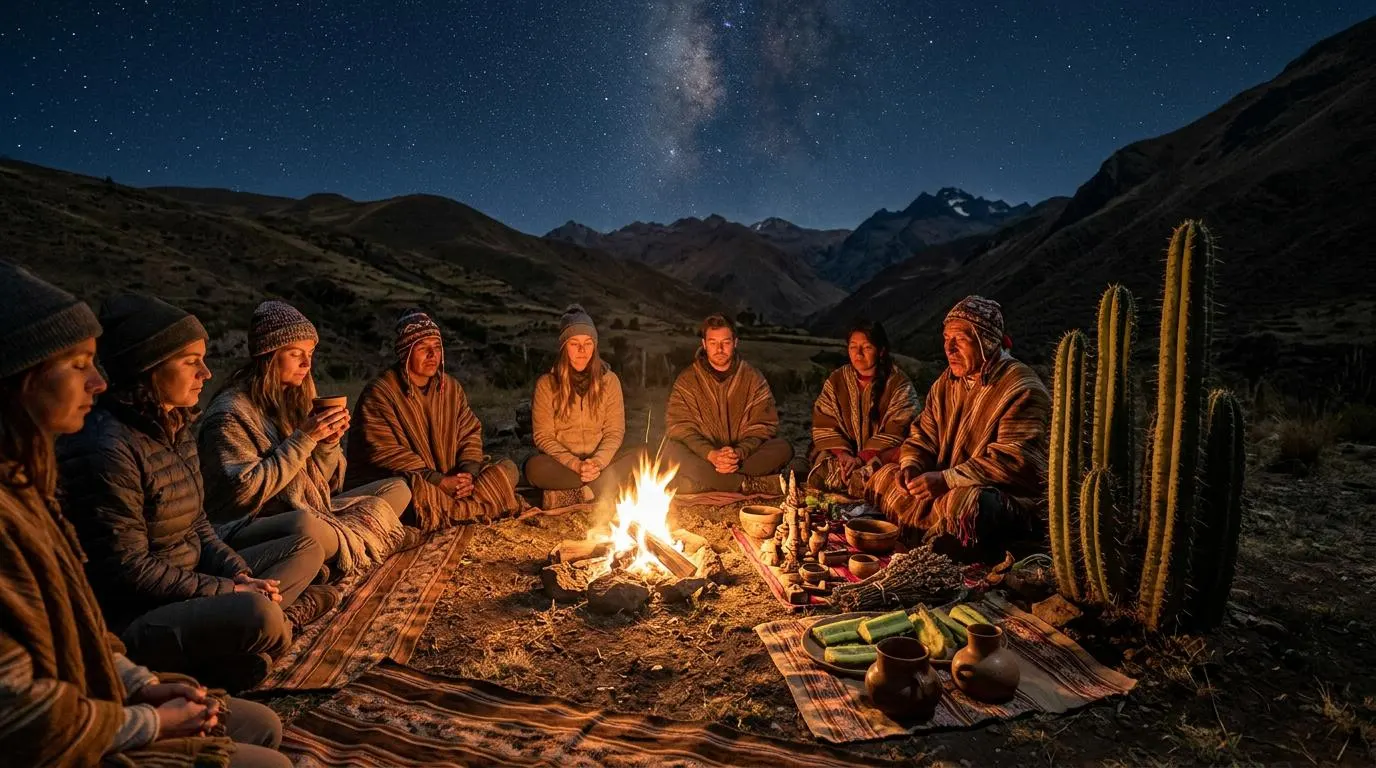
The ceremony unfolds around a Mesa—a sacred altar arranged on a vibrantly colored, hand-woven textile. The Mesa is a physical map of the cosmos, populated with dualistic power objects (artes) like pre-Columbian pottery, carved wooden staffs, crystals, and ancient river stones representing masculine and feminine forces.
The seeker drinks the intensely bitter brew early in the morning. The medicine takes hold slowly, blossoming over 1 to 2 hours and sustaining a luminous, deeply grounded plateau for 10 to 14 hours. There is rarely a violent physical purge; instead, a heavy, steady weight anchors the physical body to the earth. As the sun moves across the sky, the landscape begins to breathe. The mountain winds, the rustle of the leaves, and the ancient stones are experienced as living, speaking relatives. The practitioner is invited to walk, sit, and commune directly with the earth, returning to daily life with pristine mental clarity, an open heart, and an enduring sense of deep, unshakeable peace.