The Medicine of the Soul
Ayahuasca is a sacred, highly complex psychoactive master medicine beverage native to the vast tropical rainforests of the Amazon basin. It has been ritually prepared and consumed for hundreds, if not thousands, of years by dozens of distinct indigenous nationalities spanning Peru, Colombia, Ecuador, Brazil, and Bolivia.
The word itself originates from the indigenous Quechua language: Aya translating to “spirit,” “ancestor,” or “dead,” and Huasca (properly spelled waska) meaning “vine” or “rope.” Thus, Ayahuasca is universally known as the “Vine of the Soul” or the “Rope of the Dead.” It serves as a literal bridge between the mundane physical world and the luminous, multidimensional architecture of the spirit realm.
The Botanical Synergy
From a pharmacological perspective, Ayahuasca is a masterclass in organic chemistry, achieving its visionary potency through a perfect, binary team-up of two distinct forest plants:
- The Vine (Banisteriopsis caapi): This is the actual ayahuasca vine. It forms the foundational trunk of the brew. The vine contains powerful Harmala Alkaloids (specifically harmine, harmaline, and tetrahydroharmine). These compounds act as natural Monoamine Oxidase Inhibitors (MAOIs).
- The Leaf (Psychotria viridis or Diplopterys cabrerana): Known locally as Chacruna or Chaliponga, these leaves are packed with N,N-DMT (N,N-Dimethyltryptamine), a profound, fast-acting visionary compound.
The Chemical Key
If a human were to simply pick and eat the Chacruna leaves raw, absolutely nothing would happen. The human digestive tract naturally produces an enzyme called Monoamine Oxidase (MAO), which instantly breaks down and neutralizes DMT before it can reach the bloodstream or cross the blood-brain barrier.
By combining the leaves with the B. caapi vine, the vine’s harmala alkaloids temporarily turn off the stomach’s MAO enzymes. This allows the DMT from the leaves to pass completely unharmed through the digestive tract, entering the bloodstream to ignite a stable, multi-hour visionary journey.
What It Means to Indigenous People
To Western seekers, Ayahuasca is often approached as a therapeutic tool for personal psychoanalysis, trauma integration, or a remedy for deep depression. However, to the indigenous peoples of the Amazon—such as the Shipibo-Conibo, Huni Kuin (Kaxinawá), Yawanawá, Asháninka, and Tukano nations—the medicine holds a vastly different, foundational, and communal weight.
- The Mother and the Ultimate Teacher: Indigenous lineages do not view Ayahuasca as a chemical substance or a drug, but as an autonomous, ancient, and deeply intelligent spirit entity—often addressed affectionately as Madrecita (Little Mother) or Abuela (Grandmother). She is regarded as a sentient teacher who holds the complete blueprint of nature’s laws.
- The Living Pharmacy: In the deep jungle, where Western hospitals do not exist, Ayahuasca has historically served as the supreme diagnostic lens. Under its influence, a master healer (Curandero or Ayahuasquero) does not just receive visions for the sake of exploration; they use the expanded state to literally diagnose the physical and energetic root causes of community illnesses, locating exactly which supportive forest herbs are needed to treat a patient.
- Ancestral Cultural Governance: Within a traditional Maloca (communal longhouse), the medicine is used to clean the collective consciousness of the village. It is a tool to resolve deep interpersonal conflicts, receive artistic inspiration for tribal pottery and textiles (such as the geometric Kené designs of the Shipibo), and communicate directly with the spirits of ancestors to ensure community survival.
How It Is Used
The consumption of Ayahuasca is a highly disciplined, intensely demanding, and strictly structured ceremonial art form. It is never used casually, recreationally, or without the anchoring safety of a seasoned lineage keeper.
1. The Preparation (La Cocina)
The creation of the medicine is itself a multi-day ceremony. The men of the community harvest the thick woody sections of the vine and gently pound them with wooden mallets until the fibers split into threadlike strands. These strands are layered systematically inside a massive cauldron, alternating with thousands of hand-washed Chacruna leaves. Pure river or mountain water is added, and the mixture is boiled continuously over an open wood fire for 10 to 24 hours. The liquid is repeatedly strained, reduced, and concentrated until it transforms into a thick, dark brown, intensely bitter, and syrupy fluid.
2. The Dietary Discipline (La Dieta)
Before a participant ever touches the cup, they must undergo a strict preparatory ritual known as La Dieta. This requires abstaining from specific foods and behaviors for days or weeks prior to the ceremony:
- Eliminating Tyramine-Rich Foods: Aging cheeses, cured meats, and fermented products must be avoided, as they interact dangerously with the MAOI properties of the vine.
- Purifying the Body: Salt, refined sugars, hot spices, pork, alcohol, and pharmaceutical medications are strictly eliminated to make the physical temple as sensitive and receptive to the plant spirits as possible.
- Energetic Celibacy: Sexual activity is paused to preserve and build the individual’s vital life-force energy before entering the intense spiritual arena.
3. The Ceremony
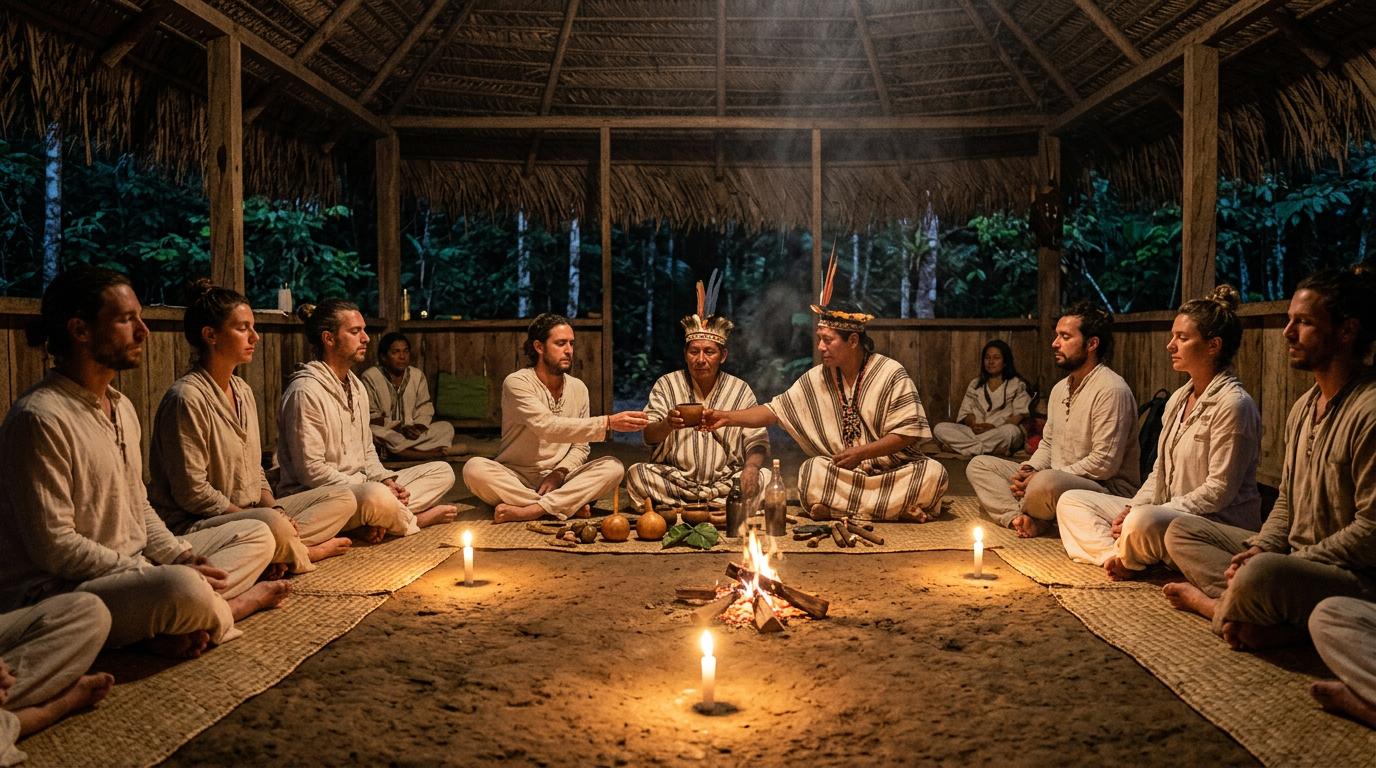
Ayahuasca ceremonies take place almost exclusively at night, inside a darkened, circular wooden longhouse. The darkness is intentional; it shuts down the outer physical senses, allowing the inner visual architecture of the medicine to unfold clearly.
The shaman opens the space by blessing the room, blowing columns of protective Mapacho tobacco smoke over the participants and the medicine cup. Each seeker is called up individually to drink a small, specific dose of the bitter brew.
4. The Icaros and the Purge
Roughly 30 to 45 minutes after drinking, the medicine begins its descent. This transition is marked by two defining elements:
- The Purge (La Purga): Ayahuasca is an intense physical purgative. Participants frequently experience deep nausea, leading to vomiting, sweating, or crying. In the indigenous tradition, this is not viewed as an unwanted side effect; it is a vital, celebrated therapeutic milestone. It is the literal physical ejection of panema—the clearing away of old emotional blockages, toxic cellular memories, ancestral trauma, and spiritual heavy weather.
- The Icaros (Sacred Chants): The shaman is the absolute pilot of the journey. As the medicine peaks, the shaman begins to sing Icaros—complex, geometric, and melodic songs received directly from the plants during long periods of isolation in the forest. These songs act as sonic steering wheels, manipulating the visionary landscape, calming participants’ anxiety, pulling seekers out of dark mental loops, and structuring the healing frequencies within the room.
The active journey typically plateaus for 4 to 6 hours. As the dawn breaks or the stars shift, the visions gently dissolve, leaving the participants deeply exhausted but profoundly light, unified, and deeply re-aligned with the core matrix of their soul.